

The World's Slowest Marathon
October 15, 2026 By Becca Stiles-Nogosek
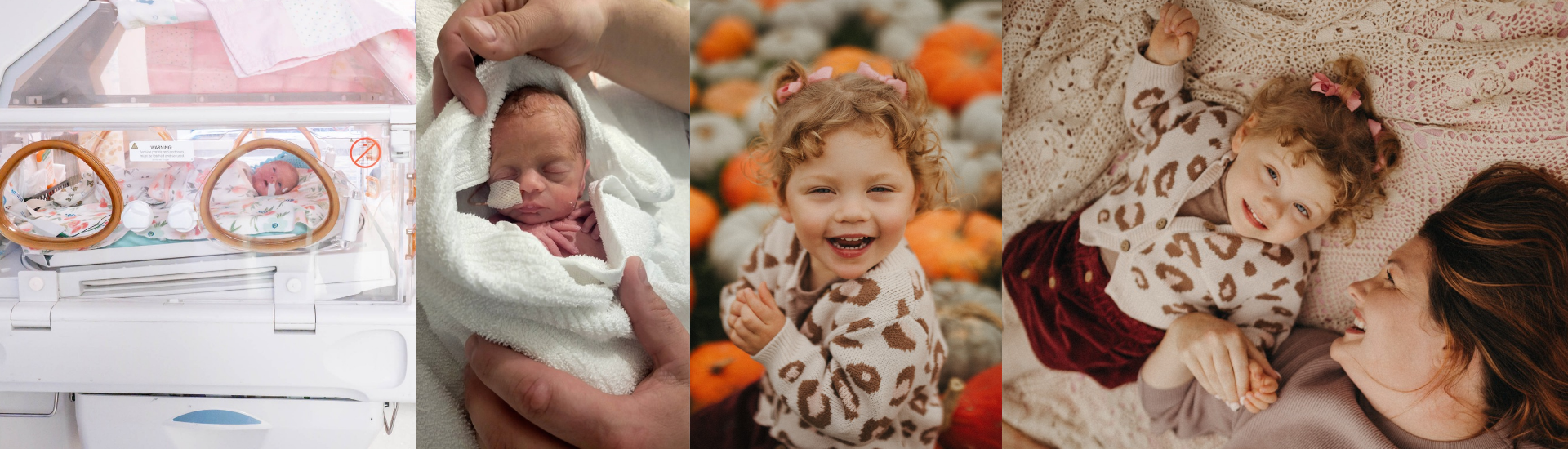
We didn't think we were going to be parents. After six years of hoping and four years of waiting to adopt, we got a notification that we never expected. I was pregnant.
My first two trimesters with our daughter, Freyja, were completely uneventful. I didn't have much illness or even discomfort.
On the evening of Easter Sunday, I started feeling weird. I wasn't exactly sick and I had no pain. I was just very, very tired and kind of "buzzy" and lightheaded. I figured it was from too much family and food, but I sent a note to my doula, who encouraged me to message my OB. They asked me to come in the next morning just to make sure everything was OK. My vitals were pretty normal, nothing elevated, but my OB recommended a preeclampsia blood screen and a blood pressure check at my glucose test that Wednesday. The screen came back negative for preeclampsia. My blood pressure was slightly elevated, but still not in a concerning range. They recommended baby aspirin and a recheck on Friday.
That Friday morning I was 29 weeks, 3 days, and I still felt totally fine. I felt so fine that I told my husband, Taylor, not to come, even though he'd been at every appointment before, because it was only supposed to be a 15-minute blood pressure check. My blood pressure was 160/102. They moved me upstairs for meds and monitoring and told me to call my husband. Taylor was installing a toilet for his grandma with my father-in-law. He told me he'd be done in an hour. I had to tell him they said he should come now.
I was really confused, because I still didn't feel that sick. They started a magnesium drip and ordered steroid injections to help the baby, "just in case." A few minutes later the on-call OB came in to tell me they were ordering an ambulance to transport me from where I'd done all my prenatal care, to [a different hospital], because they don't deliver before 32 weeks.
I said, "Deliver what? I'm not delivering anything. Not yet."
Taylor arrived shortly before the paramedics rolled in the gurney. I had never been a sick person. I had never laid on a gurney or ridden in an ambulance. They wouldn't let Taylor ride along, so he had to follow behind. The ride was only a few minutes, but all I could do was focus on my breathing, stare at the ceiling of the ambulance, and try to keep it together. That's when my headache got so much worse. I'd had migraines before, but this was like my skull was too small for my brain. I started seeing stars as we pulled into the ambulance bay.
I couldn't see anything but ceiling tiles and fluorescent lights as they moved me down the hall. I usually have a good sense of direction, but I couldn't orient myself physically or mentally. I just wanted to see my husband and know what was going to happen next.
Taylor met me in the room what felt like an hour later. By then they had already increased my meds and monitors and met with the team. The information was coming in so fast and I had no idea what was happening. I couldn't think or process anything. My head hurt so badly I could feel my pulse in my eyeballs, and my lips were starting to swell. When Taylor got there, I asked the nurse to repeat everything, because I couldn't hold on to any of it.
They were pretty sure I would have the baby that night. They started talking about odds and surgical timelines and whether I wanted to attempt labor. I told Taylor to call our doula, and I told the team I wanted to wait until she got there to make any more decisions.
Our doula, Billie, was amazing. She gave me the greatest gift: permission to ask for a minute to process. As she said, "You can always ask, and they will tell you if the answer is no."
I stayed on heavy monitoring that night. They checked my blood every hour, along with my blood pressure, and kept heart monitors on me and the baby. Around 4 a.m., a doctor came in to tell me my oxygen levels were dropping and they needed a chest X-ray. He said he'd check back in an hour, and if things hadn't improved, we'd be going to the OR. Things improved. We made it through the night, so well that they moved us out of Labor and Delivery to the antepartum floor.
The team kept monitoring closely all day and all night Saturday, with blood pressure checks and blood draws every hour or so. By Saturday night, the critical care OB said, "No baby tonight," and told me family could visit the next day if I felt up to it.
Sunday was very chill. I still didn't feel great, but not awful. My mom and my father-in-law came to visit, we had some impressively horrible hospital food, and they told me I was "in it for the long haul." They prepared me to be on antepartum for five weeks. Taylor went home for supplies, because I'd left that Friday appointment so fast I didn't even grab my shoes, let alone clothes or toiletries. They brought in a rollaway so he could stay in my room, and the monitoring slowed down.
Then Monday came.
Monday was the day of the solar eclipse. We didn't have anything better to do, so we watched the coverage from across the country: the countdowns, the parties, people traveling everywhere to see it. I stood up to look out the hospital window at the people lined up on the sidewalk, looking up at the sky. I turned to Taylor and said, "Something is wrong. I have a side ache and I can't stretch."
I was already scheduled for an ultrasound to make sure the baby was in position, "just in case." Taylor said, let's get the info from the ultrasound and see how you're feeling after that. We walked down the hall to radiology. For the first time, I was feeling really pregnant. I was barely showing, but something was moving around in a way I'd never felt before. The tech had me move into so many positions and still had trouble getting a good picture. After what felt like hours we were done, and we started the three-minute walk back to my room. That's when something really changed. I told the nurse escorting us that I did not feel good at all and that I knew something was wrong. She hooked me back up, checked my vitals, and quickly came back with the doctor. Whenever doctors show up quickly, something is going on.
I honestly don't remember the rest of that afternoon. I remember repacking all our stuff to move back to Labor and Delivery, and telling close friends and family that everything we'd said the day before was no longer true. We were back to likely having a baby, way too soon. We called Billie and told her we were being moved back. She said she was on her way and asked if we needed anything. All I wanted was a Crunchwrap. The hospital food really is comically bad.
The doctors wanted to do everything in their power to get me to 30 weeks, a milestone for lung and brain development. At that point, all I could do was cry. I was overwhelmed, I hadn't slept in days, and I felt like there was no blood left in my veins after all the blood draws. I laid my head on the pillow and stared at the ceiling. I could not physically absorb any more information or answer any more high-stakes questions. Taylor and Billie stepped in for me, because I was physically there, but mentally very far away.
I reached 30 weeks at midnight. At 12:24 a.m. we were wheeled to the OR. Freyja was born at 1:24 a.m.
The main thing I remember from the OR is the smells. They were awful. Billie asked a nurse, who brought me a little sponge with essential oils to hold under my nose. My hands were so cold and sweaty. I could hear what they were doing, but I couldn't feel much. Then I heard a squeak and a squeal that sounded like the kittens we used to find in the barn when I was a kid. They lifted the tiniest baby I had ever seen over the curtain, and all I could say was, "She's so small. She's too small."
"She's screaming, so she's breathing," the neonatologist said. He and about six of the 20 people in the OR walked out of the room. Taylor went with Freyja to the adjacent room, and I stayed with Billie while they closed me up.
Freyja was 2 pounds, 2 ounces. We only saw her for a moment before she was taken by ambulance to the NICU across town, and I was taken upstairs to recover. I didn't see her again for three days.
All I could do was cry and desperately try to produce milk my body wasn't ready to give. I have never been so tired. There was nothing to do, so I mostly sat in the dark, adjusted my bed buttons over and over, and had occasional conversations with the nurses. They set up an app on my phone where I could watch a barely visible webcam image of the tiniest baby, a person I didn't know yet. That was the most confusing part of the whole experience.
Our time in the NICU was, fortunately, much less eventful than the days that got us there. Freyja was never on oxygen, a miracle of science in itself. (Thanks, steroids!) It was a lot of mundane TV, pumping every 90 minutes, and clinging to the end-of-night weigh-in. We prayed she'd gained the 30 grams a day that became our barometer for how the next day would go. I have always been a planner, so moving my entire life into three-hour increments was bizarre. There was nothing to plan, because we never knew what was coming until the next three-hour check. It was the world's slowest marathon.
Freyja moved quickly from the critical NICU to the labor and delivery NICU because she was meeting milestones so fast. She was by far the tiniest baby there, but also one of the strongest. I hope she takes that with her for the rest of her life. After six weeks, we were discharged when she was just over 4 pounds, the minimum weight for a car seat. It's a weird benchmark, but a big one, so to speak.
So why did this happen? We don't know. The doctors don't know. That's a very disarming sentence to hear. We were so grateful to have some of the best medical care in the world for our baby at [the hospital], and even with that resource, there were gaps in our access to knowledge, because that knowledge doesn't exist yet. I had never considered that, in this day and age, there were still medical mysteries, and that I was now one of them. I always knew intellectually that women's health wasn't a priority in the U.S. But experiencing it firsthand was just as hard to believe as being told I was pregnant, that I was being admitted, and that I was going to have a 2-pound baby. I could not, and still cannot, comprehend how, in all the years women have been having babies, healthy and sick, there could be anything we don't know about the process. That's especially true for something that affects 5 to 8 percent of pregnancies, around 300,000 women every year in the U.S.
Back then I was confused. Now that Freyja is two and a half and healthy, and I've had time to get my brain back, I'm angry. I cannot accept "these things happen" without the next sentence being "and here's what we can do about it."
We need to keep advocating for the tiniest babies in the world by investing in women's healthcare and research. "The way it's always been" is no longer an excuse I'm willing to accept. We went through it and came out the other side. I'm able to tell our story because we were fortunate to have an amazing outcome, in spite of the lack of research, not because of it.
We didn't think we were going to be parents. After six years of hoping and four years of waiting to adopt, we got a...
ReadMore